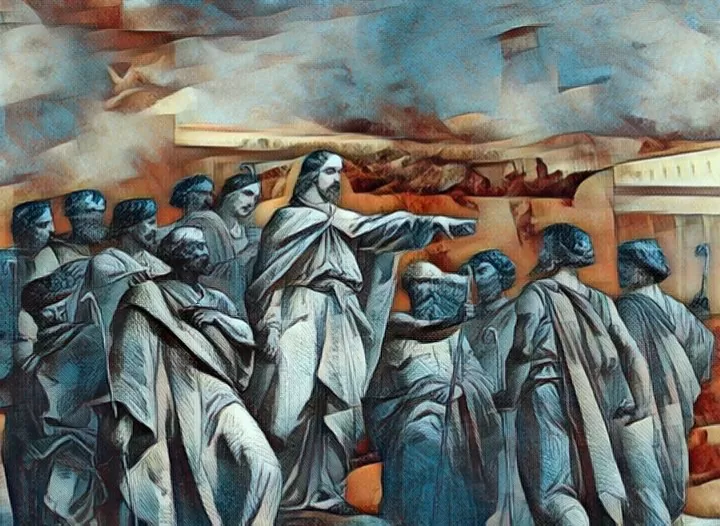
The advent of Vespasian and the good news of Jesus Christ

Mon, 06/12/2010 - 15:12

I have just finished reading an excellent essay by Craig Evans entitled “The Beginning of the Good News and the Fulfillment of Scripture in the Gospel of Mark” in Hearing the Old Testament in the New Testament (McMaster New Testament Studies), edited by Stanley Porter. I think I can just about spin this as a belated advent post.

Evans suggests that Mark portrayed Jesus as the fulfilment of Old Testament prophecy ‘as a conscious challenge to the rumors circulating in the Roman Empire that Jewish prophecy was fulfilled with the advent of Vespasian as the new emperor and, by virtue of his exalted office, the new “son of God” ’ (86). This slots into a fairly heated scholarly debate about the extent to which the “gospel” in the New Testament was framed in anti-imperial terms. I won’t attempt to summarize the arguments and counter-arguments here, but this interview with Justin Hardin, though typographically untidy, gives an impression of the debate.

Seeing Differently (and Daniel Kirk's review of The Future of the People of God)

Thu, 02/12/2010 - 15:08

I started out to write a response to some questions by Jim Hoag about my understanding of Romans 8 and then came across an excellent review of The Future of the People of God by Daniel Kirk. Since Jim’s comments and Daniel’s critique converge on the same issues, albeit from different directions, I will try to address both here.

Jim makes the point that to suggest that Romans 8 addresses the circumstances and destiny not of the ordinary Christian but specifically and pertinently of the early martyr community constitutes a “dramatic hermeneutical shift”. Indeed it does; and its implications, of course, reach beyond Romans 8. But is there any prospect of this reading gaining traction?

Ancient text and modern reader: a simple hermeneutical model

Sun, 28/11/2010 - 11:10

Here is a simple model that captures what seem to me to be the three basic constructive hermeneutical options that we have for describing how the ancient text of scripture speaks to the modern (committed) reader. There is the common understanding that the Bible as sacred text or “Word of God” speaks directly and more or less clearly to the modern reader; and there are two indirect approaches, one by the way of narrative, the other by the way of analogy.

The salvation of humanity or the salvation of Israel?

Fri, 26/11/2010 - 11:38

Paul’s statement in Romans 3:21-26 that the future justification of God has been revealed in anticipation in the present time through the faithfulness of Jesus for all who believe is clearly of central importance for our understanding of “salvation” in Paul. Discussion has centred for the most part on the twin loci of the genitive phrase dia pisteōs Iēsou Christou (“through faith in Jesus” or “through the faithfulness of Jesus”?) and the soteriological terms apolutrōsis (“redemption”) and hilastērion (expiation/propitiation).

There is, however, a more fundamental question, partly disclosed by the debate over the meaning of the genitive phrase, that needs to be brought to the surface and clarified: What exactly is spoken about by means of the soteriological metaphors? What story is being reinterpreted or redescribed by the language of redemption or atonement? Is it a story about the salvation of humanity that happens also to include Israel (this is Douglas Campbell’s surprisingly conventional assumption) or a story about the salvation of Israel that is found to have implications for humanity?

Douglas Campbell and the right(eous)ness of God

Mon, 22/11/2010 - 22:10

Douglas Campbell’s The Deliverance of God is a highly polemical argument about the nature of salvation and the character of God. It is polemical inasmuch as it is driven from the outset by a rigorous opposition to what Campbell calls “Justification theory”—the argument that salvation consists essentially in the satisfaction of divine wrath through the atoning death of Jesus, which is appropriated not by any type of work but by faith alone. Campbell maintains that Paul sets out his own understanding of salvation not in Romans 1-4 but in Romans 5-8. Salvation is the unconditional deliverance of humanity from enslavement to sin in order to participate in a new ontology—a new liberated existence—in Christ. Campbell achieves this fundamental theological realignment by ascribing all the retributive material in Romans 1-4 to a particular Jewish-Christian Teacher with whom Paul enters into fictitious dialogue.

Post-Christendom and the global church

Mon, 22/11/2010 - 13:22

A substantial gain to be had from reading the New Testament narratively rather than simply theologically is that the approach allows us to describe a meaningful continuity between the outlook of the New Testament and the subsequent history of the people of God. So, for example, it seems to me that key eschatological trajectories that arise in the New Testament land not beyond history but at critical moments in the foreseen experience of the church—most importantly, the Jewish War and the conversion of the empire.

One consequence of this change of perspective is that the European church and the age of European Christendom are significantly implicated in our interpretation of the New Testament. I think this narrative focus puts us in a much better position to resolve our current post-Christendom dilemma, but we also have to consider how the global church fits into the story. This post is a sketchy and very superficial attempt to integrate the experience of the non-Western church into the argument about the symbolic and theological significance of the collapse of Christendom.

How does scripture speak to the world?

Mon, 15/11/2010 - 17:35

The Bible is a formative text for the people of God. I have argued that it is formative primarily in a narrative or diachronic sense—that is, it speaks to the church today by narrating a critical period, a determinative trajectory, in the historical development of the people. It begins with the calling of Abraham from a classic place of empire to be the beginning of an alternative humanity, a new creation; and it culminates eschatologically in the conversion of empire to the worship of the God of Israel. The New Testament certainly looks beyond that event to a final establishment of justice and life and a final renewal of all things, but the target of the formative narrative is the victory of Christ over Rome through the faithful, self-sacrificing witness of his disciples. This is the moment at which—within the narrative constraints of the biblical outlook—the nations bow the knee and confess that YHWH, the God who has redeemed and established his people, has publicly and politically demonstrated his righteousness and has shown himself to be sovereign amongst all the gods of the pagan world (cf. Is. 45:14-25).

Do you rob temples? The Fulvia scam

Sun, 14/11/2010 - 15:20

This is a fascinating exegetical insight. Douglas Campbell notes the relevance of a passage in Josephus’ Antiquities for understanding Paul’s otherwise rather odd complaint regarding a Jew who claims to be a teacher of the Law but who steals, commits adultery, and robs temples (The Deliverance of God, 561). Why highlight the obscure and, on the face of it, rather unlikely offence of robbing temples? The interpretation advocated by Campbell serves to underline what to my mind is a critical perspective on this passage—that Paul is focused on concrete circumstances and real outcomes.

The prophetic relationship of the people of God to the “land”

Sat, 13/11/2010 - 18:20

One of the questions that came out of the recent discussion of the Beatitudes has to do with the place of the land in the eschatological restoration of the people of God. I suggested that Jesus’ promise to the “meek” was that they would inherit not the “earth” but the “land”— can mean “earth”, but the context makes “land” much more likely. The Beatitudes presupposes a narrative of judgment on Israel, which leads precisely to the question of who should inherit the land that has been judged—if it has been taken away from the unrighteous, whom will it be given to?

Scripture as the (historical) theological interpretation of history

Thu, 11/11/2010 - 16:32

This is a fundamental dilemma facing biblical hermeneutics: how do we get from scripture as ancient religious text, which is at one level at least unquestionably what it is, to scripture as Word of God for the church today, which at one level at least is unquestionably what it needs to be? Arguably it is the most serious dilemma currently facing biblical interpretation.

Pages

Subscribe to P.OST RSS

At random...

The church and social protest: counting the cost Now that St Paul’s has belatedly decided that it has enough common ground with the Occupy London protesters to work with them rather than against them, the conversation naturally turns to the question of what sort of economic policy, etc...
The coming of a ‘new world order’: why Jesus wasn’t wrong I had set out to respond rather briefly to some remarks made by paulf in a comment on my “The kingdom of God: not ‘now and not yet’” post, but in the excitement that response has swollen to the proportions of a whole new post. Paulf stated...
Sweet and Viola: A Jesus Manifesto Leonard Sweet and Frank Viola have recently issued A Magna Carta of Restoring the Supremacy of Jesus Christ, a.k.a. A Jesus Manifesto for the 21st Century Church. They argue in the preamble that Christianity is nothing more, nothing less...